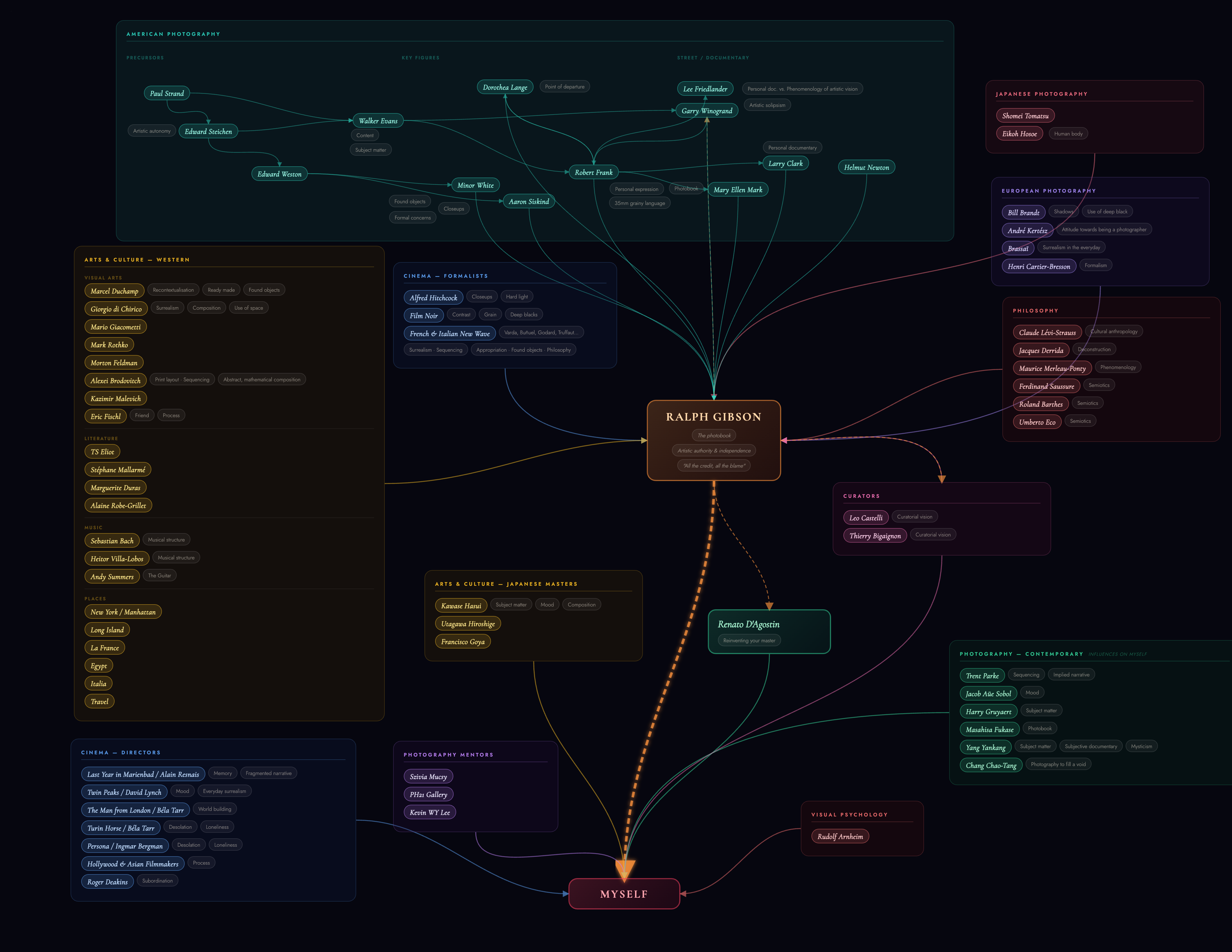
The pervasive myth of complete originality in Western culture can burden emerging artists, as though admitting an influence was giving up on individuality and authenticity. Yet I believe art is never created in a vacuum. Facing our lineage is not a weakness but a necessary acknowledgement of the tradition we inherit. We contribute our voices to the ongoing discourse by building on the groundwork others have laid. To understand my artistic evolution, I feel compelled to trace a personal and introspective map. I’m not aiming for academic rigour or complete exhaustion, but to create a chart of influence as a source of divergence.
The Encounter with Photography
My photography journey wasn’t a sudden revelation; it came later in life as an organic discovery. My time in the film industry, especially the early years was mostly about technical and organisational complexity, minute workflow issues, and a complete subordination to everyone else’s vision when making artistic decisions. Later, the immersion in cinema offered a broader understanding of narrative and visual storytelling, occasionally working with world-class directors and creatives — George Miller, Jackie Chan, Stanley Tong, Guo Fan, Lee Byung-Hun or Roger Deakins — exposing their problem-solving processes.
However, a need for personal expression was already developing, and a somewhat chance meeting with Chang Chao-Tang’s surrealism in his two-volume Time: Images made an initial impression. It was an early sign that photography might be my clearest, most resonant language, but I was lacking a starting point. The real breakthrough came through Ralph Gibson as a sudden experience. The impact of my first reading of The Somnambulist revealed complex ideas and a sense of mystery told in a fragmented narrative form — it unlocked a new way of seeing.
Ralph Gibson at the Confluence of Traditions
He started by drifting around photographing The Strip in LA in the early 1960s, rushing to join Garry Winogrand and Lee Friedlander, capturing life as it unfolded, Leica in hand, ready to react to serendipity. During a chance weekend at a lakeside house, the camera revealed something ambiguous he struggled to comprehend — a reflection of his inner world. The camera became a compass, pointed inward to explore perception and existential questions. This sparked the core of The Somnambulist and set him apart from the extroverted street photographers.
There are moments in an artist’s life when a sudden influence accelerates changes in the process. The documentary photographer, Dorothea Lange — whom he assisted in Los Angeles — introduced him to the notion of “point of departure,” unfolding an early concept during photographic exploration. Embracing this idea, Gibson traced echoes of the pointed palm leaf through Egyptian culture and I investigated the way tropical light evokes emotional intensity in my series Citramarine.
His other mentor, Robert Frank’s The Americans influenced generations with an unsettling portrayal of American society and showed Gibson that a carefully sequenced narrative can convey complex emotions and personal truths. Yet, his visual grammar couldn’t be more different: while Frank’s images feel like spontaneous and urgent confessions, Gibson’s are meditative poems or visual metaphors. Taking the best of his masters but always with a personal twist.
The integration of these distinct, parallel currents is clearest in his early photobooks — the three volumes of The Black Trilogy. By the early 1970s, he resolved this question I’m wrestling with here — how to arrive at a personal voice by building on influences, in a way that broadens the discourse. By consciously abandoning all the established styles, he forged his work into a new and distinct space. He played the abstract fragments against recognisable, almost straight renderings of human figures in The Somnambulist. To avoid the birth of “The Son of Somnambulist,” he changed his approach again and juxtaposed contradicting ideas in Déjà Vu to recall this little-understood psychological phenomenon. In the third volume, Days at Sea, he abandoned diptychs again, leaving the verso pages empty, using the fragmentary sequence to hint at a background story.
Reading these books and understanding his emphasis on artistic autonomy, encapsulated in the mantra “all the credit, all the blame,” strongly reinforced my commitment to the photobook as my primary medium of expression.
A Broader Web of Influences
First of all, a voracious intellectual curiosity led him to the reassurance of some of the intellectual giants of continental Europe. He became interested in how photographs, image pairs and sequences create meaning and where this meaning originates in society or our consciousness, investigated by branches of philosophy like semiotics, structuralism, and phenomenology — the writings of Claude Lévi-Strauss, Maurice Merleau-Ponty and Jacques Derrida.
Cinema always played a huge role in his life. The disjointed narratives of Luis Buñuel — and even more so the French and Italian New Wave directors — deeply shaped his photobook approach. Inference by proximity, rather than explicit exposition. I’ve relied on these achievements to build the haunting world of my Jamais Vu series or the surreal narrative of Midnight Eclipse centred around a rare astronomical event.
This approach resonates with the experimental music of Heitor Villa-Lobos that accompanied Gibson in his years in the Chelsea Hotel on the way to The Somnambulist. Music led him to his “overtones theory,” images placed next to each other creating “visual overtones,” new meanings created entirely in the viewer’s mind, that wouldn’t be accessible in individual images. I’m grateful to play this instrument in diptych-based works like Citramarine or Jamais Vu.
Gibson’s Heritage
His commitment to his artistic voice and risk-taking ultimately led to a successful amalgamation of these diverse impacts. Renato D’Agostin — Gibson’s assistant for over a decade — is perhaps the best example, who collaborated closely with curator Thierry Bigaignon to forge a distinct path while carrying forward certain essential visual principles. Another reason why D’Agostin became my second significant influence is his openness about his creative journey. His extensive documentation of his workflows, open photobook sharing, and discussions provide an invaluable window into his thought processes, revealing a remarkable intellectual generosity.
Points of Divergence
In my work, I never resisted his influence, because I never saw it as a stylistic model to emulate. Instead, I understand it as a conceptual framework — a “point of departure” rather than a destination. His work doesn’t prescribe a visual aesthetic for me to adopt; it offers a way of thinking about photography as an intellectual and emotional inquiry. Our lives were so different, the social, geographic, and personal distances so pronounced, that imitation was never a real danger.
As an example of where my approach diverges, he underlined the paramount importance of personal style. Yet, I’m willing to sacrifice the benefits of a monolithic style and I prioritise visual decisions based on the needs of the project — an approach I believe I’ve carried from my experience in cinema.
New Voices
Continuing with cinematic influences, Resnais’s Last Year in Marienbad, and Nolan’s Memento with their exploration of memory loss through fragmented sequences are echoed in my BLACKOUT book, where I attempt to reconstruct a night’s lost memories using photographs, bridging real-world events, through the subjective nature of editing and sequencing.
The meditative pacing and desolation of Béla Tarr’s films, such as The Turin Horse, offer inexhaustible inspiration and remind me of the importance of occasionally holding back the pacing in telling a story.
Tracing the map of photographic influences beyond Ralph Gibson, I find Trent Parke, with his dramatic contrasts, masterful sequencing and world-building, encourages me to embrace raw, emotional intensity and to pay attention to the overarching structure of the sequence in my books like Midnight Eclipse and Undercurrents.
My earliest influence, the outstanding Taiwanese photographer, Chang Chao-Tang’s perspective summarised in the quote, “Photography is not for the satisfaction of others. Neither is it some kind of responsibility or mission. It is a means to fill a personal void.” validated my yearning to satisfy my personal need for expression.
From the heritage of traditional Japanese woodblock printing, the Ukiyo-e masters Kawase Hasui and Utagawa Hiroshige have informed my understanding of framing but more importantly — together with Chinese photographer Yang Yankang — became the “point of departure” for my series The Floating World, investigating the dualities of Ukiyo, the Buddhist world of sorrow and transience.
I must also acknowledge the importance of champions and mentors like Szilvia Mucsy, contemporary photographer, festival director and curator, and PH21 Gallery, who both actively work to promote emerging artists both in Hungary and internationally.
Turning to the Future
This evolving map of influence is not a closed system. It expands with each book and each new encounter. But even now, when I turn to trace the next path forward, I sometimes feel Gibson’s presence, when I pull a copy of Deus Ex Machina or Days at Sea from the shelf — not to study like a textbook, but to reconnect. In his books, I find not a shadow, but a light on the horizon.
Andras Ikladi
Xiamen, China
2025.03.30